
2026 Presentation Abstracts & Speaker Bios
Arranged alphabetically by speaker last name.
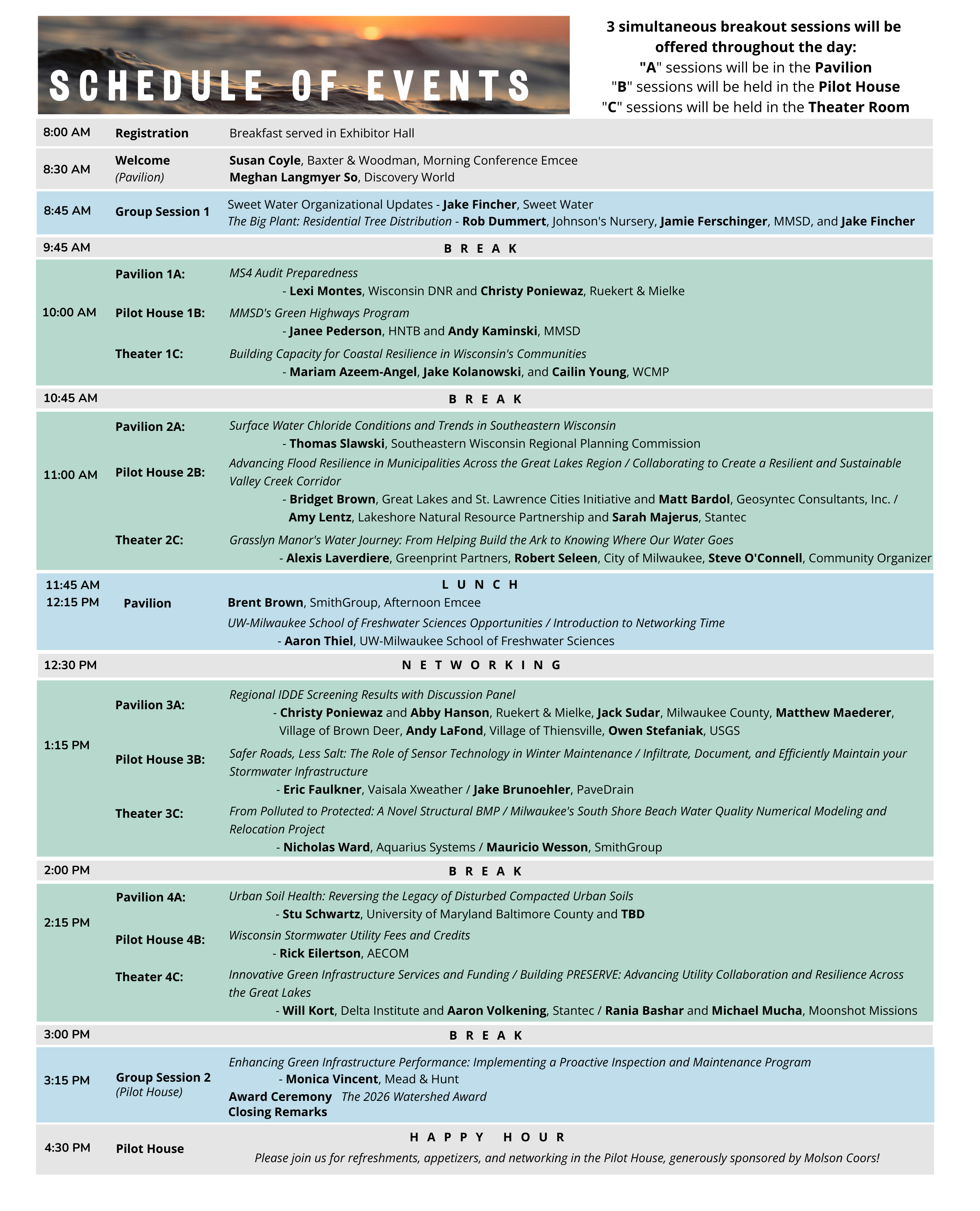
Building PRESERVE: Advancing Utility Collaboration and Resilience Across the Great Lakes
Rania Bashar, Moonshot Missions
Michael Mucha, Moonshot Missions
This session, led by Moonshot Missions, will share the PRESERVE Community of Practice’s experience and learnings from connecting municipal wastewater utilities, nonprofits, and state partners across the Great Lakes to strengthen collaboration and improve performance. Participants will hear how Moonshot designed, launched, and scaled PRESERVE—covering governance, facilitation, and peer-to-peer learning methods that build trust and momentum. The session will highlight lessons on aligning diverse stakeholders, integrating equity and funding strategies, and sustaining engagement. PRESERVE offers a replicable model for collaborative learning networks that empower utilities to address infrastructure challenges through shared knowledge and collective action.
Presenter Bio (Rania Bashar): Senior Environmental Program Manager with over a decade of experience leading water and infrastructure initiatives that strengthen environmental compliance, system resilience, and community sustainability. She oversees multi-contract portfolios funded by Moonshot's foundation partners guiding cross-functional teams and collaborating with utilities, regulators, and community stakeholders. Active with the Water Research Foundation (WRF) and CSWEA, Rania contributes to advancing applied research and professional knowledge-sharing. A graduate of the AWWA Transformative Water Leadership Academy (TWLA 2025), she is recognized for people-centered, data-driven leadership that integrates technical innovation, financial performance, and ecosystem stewardship across the Great Lakes and Chesapeake Bay regions.
Advancing Flood Resilience in Municipalities Across the Great Lakes Region
Bridget Brown, Great Lakes and St. Lawrence Cities Initiative
Flooding in the Great Lakes is expected to become more frequent and more extreme and municipalities are often on their own to manage the issue and finance solutions. Green stormwater infrastructure (GSI) is a cost-effective solution to local flooding and stormwater management. This talk will highlight efforts the Cities Initiative is working on with its members in Wisconsin and across the region, including 1) design and implementation of GSI based on comprehensive community-wide geo-physical, social and economic analyses and priority site selection; and 2) policy and financing of GSI through state revolving loan funds (SRFs).
Presenter Bio: Bridget leads the Cities Initiative's municipal education and technical support programs for drinking water, climate and coastal resilience, and water quality. Her team has supported over 100 municipalities with coastal and climate resilience planning and financing. Prior to joining the Cities Initiative, Bridget’s positions included community-based outreach (Oregon Sea Grant), higher education student engagement (UW-Milwaukee), and international water policy research (World Bank). Bridget grew up in the Michigan and currently lives in Milwaukee, Wisconsin.
Infiltrate, Document, and Efficiently Maintain your Stormwater Infrastructure
Jake Brunoehler, PaveDrain
Stormwater management is a significant infrastructure expense—but how confident are you in your BMP’s actual performance? As Henry Ford once said, “The most expensive system ever sold is the one that does not work.” Why invest in maintenance if it’s not needed? This session explores how permeable systems, as part of Low Impact Development (LID), can reduce or even eliminate long-term stormwater infrastructure costs while minimizing environmental impact. We’ll highlight the INFIL-Tracker post-construction monitoring system and present a Wisconsin watershed case study demonstrating quantifiable stormwater capture using real-world data.
Presenter Bio: Jake Brunoehler, P.E. is the National Sales Manager for PaveTank, a division of PaveDrain, where he specializes in stormwater modeling, infrastructure design, and sustainable construction practices. A licensed professional engineer in Wisconsin, Jake holds a B.S. in Civil Engineering from Valparaiso University and has held engineering roles with Patrick Engineering, SME, and Norfolk Southern Railway. He is the past president of ASCE’s Southeast Branch and serves as director-at-large for the Wisconsin Section, contributing to multiple Infrastructure Report Cards. Outside of work, Jake enjoys woodworking, home-brewing, and performing in a traditional Irish band with his wife.
Wisconsin Stormwater Utility Fees and Credits - Ways to incentivize private stormwater facilities without breaking the bank
Rick Eilertson, AECOM
Rick will provide highlights of the Wisconsin Stormwater Utility Fee and Credit Database that he maintains through the Wisconsin Chapter of the American Public Works Association (APWA WI). This includes rates and links to various credit policies for 123 stormwater utilities throughout Wisconsin. Rick will outline three (3) different examples of credit policies used in Wisconsin and lead an interactive discussion of the pros and cons of each policy, including how each credit policy serves to incentivize the inspection and maintenance of private stormwater infrastructure. Attendees will be able to take lessons learned back to their respective communities to consider enhancements that ensure private stormwater facility owners are doing their part without breaking the bank of the municipality.
Presenter Bio: Rick earned his Bachelor of Science degree from UW-Madison in Civil & Environmental Engineering in 1993 and has worked in the municipal engineering field since 1990. Rick’s early interest in community involvement and environmental issues began in 1972 when, as a child, he helped his parents (Orie & Kit) create a recycling drop off program through their church in the Village of Mukwonago. Rick absorbed much of his interest in environmental conscience and responsibility through his parents and grandparents as he grew up on a Sand County Farm in Wisconsin, practicing firsthand Aldo Leopold’s land ethic of striving to live on a piece of land without spoiling it.
Safer Roads, Less Salt: The Role of Sensor Technology in Winter Maintenance
Eric Faulkner, Vaisala Xweather
Winter maintenance is especially challenging due not only to variability in weather and climate, but also to variations across the road network including bridges, steep grades, shaded roadways, and areas influenced by water or elevation changes. Maintaining safety in these locations without overapplying materials is a growing priority for communities focused on efficiency and environmental sustainability.
This session will examine how modern road weather and pavement sensor technology provides real-time, location-specific data to support more precise winter maintenance decisions. By improving visibility into actual road conditions, these technologies help agencies better time treatments, prioritize high-risk areas, and reduce unnecessary salt usage. Attendees will learn how sensor data can be applied in both planning and operations, with real-world examples demonstrating how agencies are improving safety while lowering material costs and environmental impact.
Presenter Bio: Eric Faulkner is a Meteorologist & Weather Advisor with Vaisala Xweather. He has a degree in meteorology from The Ohio State University. For 15 years, Eric has been helping businesses in a variety of industries to better manage the risk weather poses to their operations. Most recently, he has been assisting winter maintenance professionals with weather and road weather education and is advocating for the use of new technology to increase efficiency. Eric is originally from Pittsburgh, PA but currently resides in Charleston, SC, where he has been for the last 10 years.
Innovative Green Infrastructure Services and Funding
Will Kort, Delta Institute
Aaron Volkening, Stantec
Many communities are interested in Green Infrastructure (GI) to mitigate chronic or acute flooding and address TMDL and MS4 compliance. However, small- to mid-size municipalities often lack the necessary experience, resources, and capacity for successful GI implementation. Delta Institute, a Midwest environmental non-profit, along with key partners Stantec, Regiment Securities, and 389nm, offers an innovative platform to help communities overcome barriers. We have developed a fully integrated project delivery and financing service to help municipalities identify, plan, develop, implement, fund, and maintain GI projects to address flooding issues, and stormwater sediment and nutrient loads, as well as provide other environmental, social, and economic co-benefits. The program provides technical assistance, project management, and grant funding support, with optional low-cost financing, to facilitate and expand GI at all scales. Support options range from a comprehensive turn-key program to a range of targeted services that address specific community needs.
Presenter Bio (Will Kort): As a Specialist in Delta Institute’s Nature-Based Climate Solutions portfolio, Will helps communities research, plan, finance, and implement innovative environmental projects that enhance climate resilience. Will has over a decade of experience as a water policy consultant in the Great Lakes region, with expertise in green infrastructure, sustainable agriculture, local food systems, watershed planning, and drinking water quality and access. He has worked with the public and private sectors, environmental NGOs, civil society, and academia to advance equitable environmental policies. He has served as adjunct faculty at the University of Wisconsin-Milwaukee’s School of Freshwater Sciences. Will has a Master of Urban Planning/Public Administration, and a PhD in Freshwater Sciences from UW-Milwaukee.
Grasslyn Manor’s Water Journey: From Helping Build the Ark to Knowing Where Our Water Goes
Alexis Laverdiere, Greenprint Partners
Rob Seleen, City of Milwaukee Department of Public Works
Steve O'Connell, Community Organizer
Grasslyn Manor continues in its third year of investigating its water issues and finding solutions thanks to engaged residents, partners and the City. Learn about the successful pilot to advance a major solution in combating basement backups: the Private Property Infiltration & Inflow (PPII) Reduction Project. Following robust testing, eligible residents can receive grant-funded sump pumps, lateral replacements and downspout disconnections. Hear from City of Milwaukee Department of Public Works Flood Hazard Mitigation Manager Rob Seleen, Community Organizer Steve O’Connell, and Advisory Group members in this panel moderated by Greenprint Partners Senior Project Specialist Alexis Laverdiere. Project testimonials, artwork and videography by Michael Timm and Kelly VanZant.
Presenter Bio (Alexis Laverdiere): Alexis develops and implements equitable climate resilience and green infrastructure strategies for municipalities, counties and water utilities. She leads collaborative efforts with clients, community-based organizations, property owners and residents to ensure solutions are tailored to local needs and grounded in community priorities. Alexis is passionate about building more just, resilient communities and is driven by the belief that inclusive planning can lead to long-term environmental and social benefits. She brings deep expertise in community engagement, strategic communication and stakeholder facilitation, with a talent for listening and responding to community priorities that inspire action.
Collaborating to Create a Resilient and Sustainable Valley Creek Corridor
Amy Lentz, Lakeshore Natural Resource Partnership
Sarah Majerus, Stantec
The Valley Creek Corridor is a roughly 1.8-mile city-owned corridor in Port Washington, Wisconsin. Flooding, erosion, poor water quality and infrastructure vulnerabilities required the City to fully reimagine this space. LNRP and Stantec have worked in partnership with the City to undertake this $17 million project, with almost no cost to the City and tax payers. This project includes a robust community outreach strategy and a fully nature-based design. The proposed enhancements to municipal stormwater systems, along with the restoration of urban streams and riparian ecosystems, will deliver a comprehensive green infrastructure solution that also expands opportunities for community access and recreation in the City of Port Washington.
Presenter Bio (Amy Lentz): Amy Lentz is the Interim Executive Director of Lakeshore Natural Resource Partnership, stepping into this role with 10 years of experience in nonprofit work. She specializes in community building and environmental advocacy. Amy has a bachelor’s degree from UW- Madison in Environmental Science and History, and a Masters in Freshwater Science and Technology from UW- Milwaukee’s School of Freshwater Science.
MS4 Audit Preparedness
Lexi Montes, Wisconsin DNR
Christy Poniewaz, Ruekert & Mielke, Inc.
Municipal Separate Storm Sewer Systems (MS4) convey storm water runoff to surface water resources. Currently, 245 communities are regulated through MS4 permits, administered by the Wisconsin Department of Natural Resources (DNR). The MS4 permits require documentation and implementation of six minimum control measures intended to reduce stormwater pollutants to the maximum extent practicable: Public Education & Outreach, Public Involvement & Participation, Illicit Discharge Detection & Elimination, Construction Site Pollutant Control, Post-Construction Storm Water Management, and Pollution Prevention Programs. Christy Poniewaz with Ruekert Mielke will present on each of the permit program elements and best practices for audit preparedness (maintain programs, inspect facilities, outline procedures, conduct training, public involvement, etc.). Additionally, Lexi Montes with the WDNR will present on the MS4 Audit process from pre-audit, during the audit, and post-audit follow up to better prepare MS4 Permittees.
Presenter Bio (Lexi Montes): Lexi has been with the DNR for 3.5 years, implementing the municipal stormwater program (i.e., MS4 Permit) by leading the region's MS4 compliance efforts in Southeast Wisconsin. Lexi enjoys coordinating/managing projects and places a strong value on relationship building in the workplace. Beyond Lexi's core work activities, she finds it important to connect with individuals who are looking for career advice and/or help answer questions about careers at the WDNR.
MMSD's Green Highways Program
Janee Pederson, HNTB
Andy Kaminski, Milwaukee Metropolitan Sewerage District
MMSD’s Green Highways Program is an ongoing partnership between the Milwaukee Metropolitan Sewerage District (MMSD), the Wisconsin Department of Transportation, and the City of Milwaukee to install green infrastructure under and/or adjacent to freeway overpasses across MMSD’s service area. Highway runoff carries a variety of pollutants including heavy metals, oils, salt, and suspended solids. Through the Green Highways Program, innovative green infrastructure installations are engineered to capture, absorb, and store stormwater runoff redirected from highway downspouts before it drains, untreated, into the sewer system or into nearby rivers. Key benefits of the program include treatment and storage of the first inch of rainfall from impervious surfaces, improved water quality by reducing pollutants entering waterways, transformation of underutilized areas into community assets and the opportunity to provide environmental education. Projects have been completed at the Marquette Interchange, Becher Street, Mineral Street, and Port Milwaukee overpasses. Design is underway at the Holt Avenue Overpass and other areas are under consideration for future projects. MMSD and HNTB will provide an overview of the program and discuss specifics from planning to design, construction and continued maintenance of these projects.
Presenter Bio (Janee Pederson): Janee Pederson, P.E., is a Water Resources Project Engineer at HNTB in Milwaukee. Locally, she has worked on several watercourse and green infrastructure projects for MMSD over the past decade. She was the project engineer for MMSD’s recently completed Port Milwaukee Overpass Green Infrastructure project and is the project engineer for the next project site in the MMSD’s Green Highways program, the Holt Avenue Overpass Green Infrastructure project. Janee received her Master of Engineering in Environmental and Water Resources from the University of Wisconsin-Milwaukee and is a licenses Professional Engineer (PE) in Wisconsin.
Trees for Stormwater Management and Community Building
Emily Peters, Johnson's Nursey
Jamie Ferschinger, Milwaukee Metropolitan Sewerage District
Jacob Fincher, Sweet Water
Impervious surfaces in urban areas are the main cause for stormwater runoff which is a primary source of water pollution in cities. There are many forms of green infrastructure that can help alleviate run off, but one of the simplest ways to combat run off is by planting Trees. In this presentation, we will talk about trees as a stormwater management tool in Milwaukee, what are the best trees to plant for stormwater absorption, and highlight tree planting efforts that are currently happening in Milwaukee communities.
Presenter Bio (Emily Peters): Emily is a wholesale sales representative with Johnson's Nursery, she has over five years of experience working in the green industry, she has several years of experience working in ecological restoration in the Milwaukee area and currently helps to support a variety of non-profit organizations in their tree procurement for community tree projects. She also has a bachelor's degree in Conservation and Environmental Science from the University of Wisconsin-Milwaukee. Emily is passionate about improving Milwaukee's green spaces and communities through supporting tree programs and educating others on the value of native plants in our urban community!
Regional IDDE Screening Results with Discussion Panel
Christy Poniewaz, Ruekert & Mielke, Inc.
Abby Hanson, Ruekert & Mielke, Inc.
The first part of the session is a presentation of multiple years of IDDE screening results for several MS4-permitted communities in the region (excluding bacteria). We will discuss the range of results through graphs and charts and how the results compare to guidance and requirements for MS4 permit compliance. This presentation will include discussions of where pollutants may originate when no identifiable sources or illicit discharges are found. The second part of the presentation will be a panel discussion aimed at increasing discourse between MS4 permittees and stakeholders throughout the watershed. The panel will include MS4 permittee representatives, as well as state and regulatory agency staff who specialize in areas such as storm water, contamination, monitoring, etc. (Note: The presented data will not include location or permittee-specific information.)
Presenter Bio (Christy Poniewaz): Christy Poniewaz is a Senior Environmental Scientist with Ruekert & Mielke, Inc. Christy specializes in storm water permit compliance program development and management, storm water quality modeling, and a variety of environmental surveys, inspections, and planning services.
Urban Soil Health: Reversing the Legacy of Disturbed Compacted Urban Soils
Stu Schwartz, University of Maryland Baltimore County
Standard land development practices with cut-and-fill mass grading produce a pervasive legacy of disturbed compacted urban soil profiles that increase stormwater runoff and limit infiltration, root growth, and vegetation success, in the urban pervious landscape. This presentation describes means, methods, specifications, and stormwater credits that can reliably restore environmental services and institutionalize the cultivation of healthy urban soils as a superior sustainable best management practice. The pervasive legacy of disturbed compacted urban soil profiles represents a significant opportunity to improve hydrologic design and advance stormwater management by restoring hydrologic function to the urban pervious landscape.
Presenter Bio: Stu Schwartz is a Senior Research Scientist at CUERE at UMBC. His research focuses on water resources management, green infrastructure, and urban hydrologic science. Before joining UMBC, he directed the Center for Environmental Science Technology and Policy at Cleveland State University; was Associate Director of the Water Resources Research Institute at the University of North Carolina, and Directed the Section for Cooperative Water Supply Operations (COOP) at the Interstate Commission on the Potomac River Basin.
Surface Water Chloride Conditions and Trends in Southeastern Wisconsin
Thomas Slawski, Southeastern Wisconsin Regional Planning Commission
This presentation will summarize the historical (1960s-present) and existing conditions and trends in chloride concentrations in surface water streams and lakes as part of the Commission’s Chloride Impact Study. This talk presents key findings of Technical Report No. 63, which goal was to determine the extent waterbodies in the study area have been impacted by chloride pollution and to what degree chloride conditions in these waterways are improving, becoming worse, or remaining stable. This information combined with classification data such as watershed size, percent composition of urban and rural land uses, and land use changes over time were included in this analysis.
Presenter Bio: Thomas Slawski has over 30 years of experience in aquatic ecology specializing in stream habitat and fisheries assessments, design, and restoration techniques. He has received a B.S. Biological Sciences, University of Michigan-Ann Arbor, in 1991, and Ph.D., Biological Sciences, University of Wisconsin-Milwaukee, in 1997. He has been employed at the Southeastern Wisconsin Regional Planning Commission since 1998 and currently holds the position of Chief Biologist of the Natural Resources Planning and Management Division, which specializes in wetland delineation and primary environmental corridor assessments, natural areas and critical species habitat protection, as well as lake and stream management/restoration planning.
Enhancing Green Infrastructure Performance: Peoria’s Proactive Inspection and Maintenance Program
Monica Vincent, Mead & Hunt
Proactive inspection and maintenance of green infrastructure (GI) is vital for sustaining performance and minimizing impacts that cause flooding or bypass flow. This presentation provides strategies for setting inspection schedules, maintenance triggers, and activity frequency, customized by GI asset type, sediment and debris load, and site conditions. Highlighting Peoria, IL’s transition to a proactive GI management program, it demonstrates how routine inspections and planned maintenance improve reliability, reduce reactive maintenance, and support efficient staff planning.
Presenter Bio: Monica is a Project Engineer at Mead & Hunt with experience in stormwater, green infrastructure, water treatment, H&H modeling, and collection systems. Monica has a B.S. from Missouri University of Science and Technology in Civil Engineering and a M.S. from Milwaukee School of Engineering in Water Resources Engineering and is a credentialed Envision Sustainability Professional.
From Polluted to Protected: How Aquarius Systems, The Harbor District, and Sweetwater Support Healthy Waterways with a Novel Structural BMP
Nicholas Ward, D&D Products Inc., Aquarius Systems Division
From Polluted to Protected showcases the TrashVeyor, a new marine debris capture system designed to intercept floating debris before it travels downstream. Installed at strategic locations, the TrashVeyor automatically conveys trash from the water surface to a land-based dumpster, reducing manual labor, improving safety, and supporting cleaner waterways. Our local partners, Sweetwater and The Harbor District, were engaged to assist with public outreach, and to count, categorize, and analyze the captured debris. This presentation will highlight system design, field performance, and key findings, to demonstrate how combining reliable mechanical capture and data collection can help communities prioritize interventions, measure impact, protect aquatic environments, and inform the public.
Presenter Bio: Nicholas Ward is the Sales & Business Development Manager for Aquarius Systems, the world’s leading manufacturer of surface water management equipment. The company and its customers play a vital role in environmental stewardship. This is achieved by deploying aquatic plant harvesters, marine debris skimmers, and other specialty equipment to keep waterways clean and trash free. In his role, Nicholas focuses on building long-term partnerships, expanding global markets, and supporting communities in implementing surface water solutions that protect natural habitats and promote sustainable waterway management.
Milwaukee's South Shore Beach Water Quality Numerical Modeling and Relocation Project
Mauricio Wesson, SmithGroup
Southshore Beach in Milwaukee was plagued by frequent high concentrations of E.coli. While it is understood that actual concentrations of E.coli are a culmination of a number of variables including point source(s), concentrations, and climatological conditions, advanced environmental numerical modeling considering advection, diffusion, and E.coli die-of rate provided the necessary insight into the relocation site and proposed structures to improve the water quality and reduce the number of days the beach would be closed. The relocation of the beach along with the improved circulation will reduce the number of beach closures creating a cleaner beach for the users of Milwaukee.
Presenter Bio: Mauricio Wesson is a civil engineer with over 20 years of professional experience specializing in coastal and environmental engineering. In 2002, he completed a postgraduate program in Hyogo, Japan, focused on the planning and design of coastal structures, during which he worked with Japan Port Consultants. He later earned a Master of Science degree from Delft University of Technology in the Netherlands, following an Erasmus Mundus program that included studies in Norway, Barcelona, and the Netherlands. Mauricio has extensive expertise in environmental numerical modeling, which he leverages to provide valuable insights into a wide range of coastal and water-related projects.